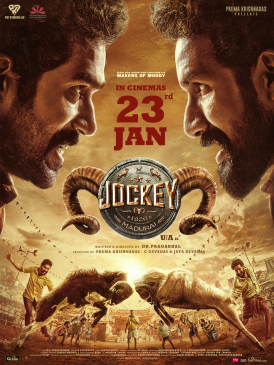
Jockey (2026) Movie Review – A Gritty Pan-India Action Drama Rooted in Rural Tradition
Title: Jockey
Release Year: 2026
Genre: Action, Drama
Director & Writer: Dr. Pragabhal
Producers: Prema Krishnadas, C. Devadas, Jaya Devadas
Production Company: PK7 Studios LLP
Music Composer: Sakthi Balaji
Cinematography: N. S. Uthayakumar
Editing: N. B. Srikanth
Runtime: Approx. 147 minutes
Languages: Tamil (dubbed in Hindi, Telugu, Kannada, Malayalam)
Jockey (2026) is an unconventional Indian action drama that boldly ventures into unexplored cinematic territory. Set against the rugged rural landscape of Madurai, Tamil Nadu, the film brings to the screen a fiercely competitive traditional sport rarely represented in mainstream cinema. Written and directed by Dr. Pragabhal, Jockey positions itself as both a cultural document and a high-stakes drama, blending realism, action, and emotional intensity.
Plot Synopsis
The narrative of Jockey revolves around the underground world of traditional goat fighting, a sport deeply rooted in local pride and generational legacy. The story follows a determined young handler who inherits not just livestock, but the burden of family honor tied to victory in the arena.
As rivalries intensify, competitions become more than physical contests—they evolve into battles of ego, survival, and social standing. Each match carries consequences beyond the ring, affecting families, relationships, and entire communities. The protagonist’s rise is met with fierce opposition from an equally driven rival, turning the sport into a symbol of personal identity and unresolved conflict.
The film gradually peels back the spectacle to expose moral dilemmas, power struggles, and the emotional toll of obsession with victory. What begins as a sports-driven narrative ultimately transforms into a layered drama about ambition, tradition, and the cost of legacy.
Performances and Character Work
Yuvan Krishna – A Grounded Protagonist
Yuvan Krishna anchors the film with a restrained yet emotionally resonant performance. His portrayal captures both physical grit and internal conflict, effectively conveying the weight of inherited responsibility. Rather than leaning into heroic exaggeration, his performance feels rooted in realism, aligning with the film’s grounded tone.
Ridhaan Krishnas – Rivalry with Depth
As the antagonist, Ridhaan Krishnas avoids one-dimensional villainy. His character is driven by similar motivations—respect, recognition, and survival—making the rivalry feel authentic and emotionally charged. The tension between the two leads forms the backbone of the film’s dramatic momentum.
Ammu Abhirami – Emotional Counterbalance
Ammu Abhirami delivers a nuanced supporting performance, providing emotional grounding amid the aggression and competition. Her role offers insight into the personal cost of the sport, particularly on relationships often sidelined by ambition and pride.
The supporting cast, including Madhusudhan Rao and ensemble performers, contributes to the film’s immersive rural atmosphere, adding texture without overpowering the central narrative.
Direction and Screenplay
Dr. Pragabhal’s direction is confident and deliberate. His screenplay prioritizes authenticity over formula, allowing the story to unfold at a measured pace. Rather than rushing from one action sequence to another, the film invests time in world-building and character motivations.
The director’s greatest strength lies in his refusal to romanticize conflict unnecessarily. While the sport is depicted with intensity, it is never glamorized without consequence. This balance gives Jockey a serious dramatic weight uncommon in conventional action dramas.
Themes and Narrative Depth
Tradition vs. Progress
At its core, Jockey examines the tension between preserving tradition and adapting to modern realities. The sport becomes a metaphor for cultural identity—something both revered and questioned by the younger generation.
Masculinity and Honor
The film explores how concepts of honor and masculinity are constructed and inherited. Victory is not merely about winning matches but about fulfilling expectations imposed by family and society.
Obsession and Consequence
As the narrative progresses, ambition turns into obsession. The film does not shy away from portraying the emotional and ethical consequences of prioritizing pride over humanity.
Cinematography and Visual Language
Cinematographer N. S. Uthayakumar captures Madurai’s landscapes with a raw, unfiltered aesthetic. Dust-filled arenas, sun-scorched fields, and crowded village gatherings lend the film a documentary-like realism.
Action sequences are shot with clarity rather than excess, favoring close-quarters intensity over stylized spectacle. This visual approach reinforces the film’s grounded tone and enhances viewer immersion.
Music and Sound Design
Sakthi Balaji’s soundtrack plays a crucial role in shaping the film’s emotional rhythm. The music draws heavily from regional influences, using percussion-driven themes to heighten tension during competitions and subdued melodies to underscore quieter, introspective moments.
Rather than dominating scenes, the score complements the narrative, allowing silence and ambient sound to amplify realism when needed.
Editing and Pacing
Editor N. B. Srikanth maintains a steady narrative flow across the film’s lengthy runtime. While the second act occasionally lingers, this deliberate pacing allows character arcs to breathe and conflicts to escalate organically.
The climactic sequences are tightly edited, delivering emotional payoff without resorting to overindulgent action tropes.
Strengths and Weaknesses
Strengths
-
Unique subject matter rarely explored in Indian cinema
-
Authentic rural setting and cultural detail
-
Strong central performances
-
Grounded direction with thematic depth
Weaknesses
-
Extended runtime may test some viewers’ patience
-
Niche subject matter may not appeal to all audiences
-
Limited humor or levity in an otherwise intense narrative
Final Verdict
Jockey (2026) stands out as a bold, culturally rooted action drama that challenges conventional genre expectations. By focusing on an unconventional sport and framing it through human conflict rather than spectacle alone, the film delivers a compelling and thought-provoking experience.
While its serious tone and deliberate pacing may limit mass appeal, Jockey succeeds as a meaningful cinematic exploration of tradition, rivalry, and identity. It is a film that rewards patient viewers with emotional depth and cultural insight, marking Dr. Pragabhal as a filmmaker unafraid to take creative risks.